



A significant portion of an agent’s time goes toward finding the buyers and sellers who make real estate transactions possible. At the core of every successful real estate business is a lead generation strategy that keeps the pipeline full and consistent over time.
For newer agents, building that pipeline can feel overwhelming at first. However, lead generation is a skill—and like any skill, it develops with practice and refinement. That said, there is no single method that works universally. In reality, most effective agents find one or two approaches that align with their strengths and build their prospecting habits around those.
At Charles Rutenberg Realty, we have seen new agents struggle to acquire clients early in their careers. We have designed this guide to address that directly. Below, we cover multiple client-finding methods you can begin incorporating into your schedule today. Additionally, we will explain how many clients agents realistically manage at one time and how to keep those relationships organized. By the end, you will have a practical framework for building a consistent pipeline that sustains a career in real estate.

How to Get Clients as a Real Estate Agent: 10 Proven Methods
The lead generation strategies that produce consistent results combine multiple skills and touchpoints. These include relationship building, marketing, networking, and deliberate follow-up. After every interaction with a potential client, effective agents document the conversation and stay in touch over time. That consistency builds trust that keeps you top of mind when someone is finally ready to buy or sell.
In this guide, we’ll cover a range of client acquisition strategies that you can begin incorporating into your business. Methods include cold calling, open houses, social media, referral systems, and professional networking. Importantly, you do not need to implement all of them. However, finding two or three methods that fit naturally into your working style and committing to them is what builds sustainable pipelines and a successful business model.
For a broader look at how to position yourself in front of potential clients, review our guide “Marketing for Realtors.”

Do Real Estate Agents Have to Find Their Own Clients?
Finding clients is a core responsibility of every real estate agent. While brokerages vary in how much lead support they provide, the majority of clients an agent works with come through their own prospecting efforts.
Building a sustainable business requires a lead generation strategy that consistently brings new contacts into the pipeline. That means actively meeting potential clients at open houses, networking events, and community gatherings. It also means maintaining a digital presence that generates online inquiries.
In reality, the goal is not to simply collect contact information. The goal is to build relationships with people who will eventually buy or sell a home. And in a competitive market such as Clearwater, you want them to think of you when they are ready to do so.
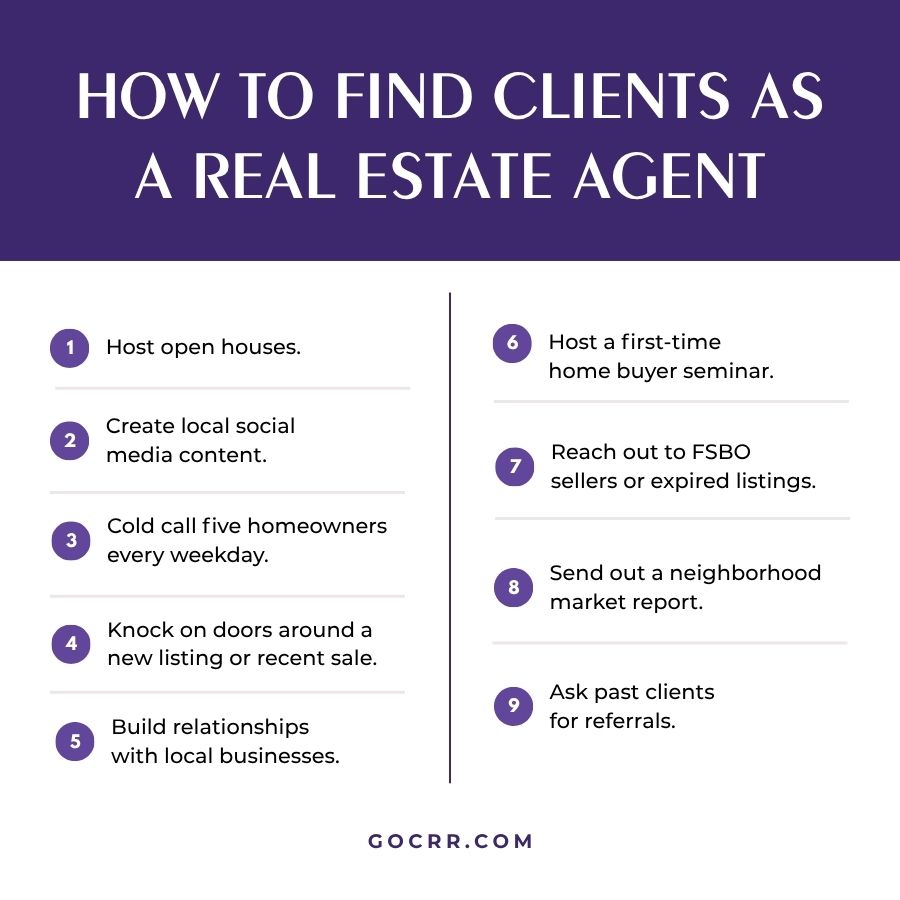
How to Find Clients as a Real Estate Agent
Host open houses.
Open houses are one of the most direct ways to meet prospective home buyers in person. Visitors who walk through the door are already engaged in the process. Some are actively searching and close to making a decision, while others are in the early stages. Nevertheless, both groups are worth your attention.
The in-person nature of an open house gives you the opportunity to make a genuine first impression and start a real conversation. That’s something digital marketing alone cannot replace.
However, it is the follow-up after the event that determines whether that initial connection develops into a client relationship. Collecting email addresses from every visitor and reaching out within 24 hours keeps the momentum going. It also demonstrates your responsiveness, which is something buyers remember.
Do you want a closer look at how open houses contribute to an agent’s business? Review our guide “What Percentage of Homes Sell from an Open House?”
Create local social media content.
Social media remains one of the most underutilized lead generation tools available to real estate agents. Platforms like Instagram and TikTok use algorithms that put your content in front of people who are most likely to engage with it. That means consistent, well-crafted posts can reach potential clients you would never encounter through traditional prospecting. More specifically, agents report that 52% of social media leads are high-quality, a rate that is double what the MLS produces.
Creating locally focused content—new listings, market updates, neighborhood spotlights—demonstrates your expertise. Meanwhile, it attracts people who are either already in your market or actively considering a move to the area. Over time, that visibility builds familiarity and trust that prompts people to reach out when they are ready to make a move.
For a practical breakdown of how to use social media to grow your business, review our guide “Social Media for Realtors.”
Cold call five homeowners every weekday.
Cold calling is one of the most direct prospecting methods available to real estate agents. Agents who make 20 calls per day convert 10-20% of their contacts into clients over the course of a year. That is a meaningful return for a disciplined daily habit. Blocking out an hour each weekday specifically for outbound calls can have a significant cumulative impact on your pipeline over time.
What makes cold calling effective is the directness of the interaction. Unlike a social media post that someone can scroll past or an email that goes unopened, a phone call starts a real conversation. That conversation is where you can build rapport and uncover motivation.
However, it requires discipline and a willingness to handle rejection consistently. Ultimately, the agents who commit to it as a daily habit tend to see results that more passive strategies cannot match. For guidance on what to say when someone picks up, review our guide “Real Estate Cold Calling Scripts.”
Knock on doors around a new listing or recent sale.
Door knocking offers a face-to-face alternative to cold calling, allowing agents to start direct conversations with homeowners in targeted neighborhoods. The most natural opportunities arise when you have an active listing nearby or have just sold a property in the area. Moreover, rising local home values also create openings. These are all compelling reasons for homeowners to listen to what a knowledgeable agent has to say.
The key to making door knocking effective is leading with value rather than a pitch. Bringing a one-page market update or leaving a door hanger with your contact information gives homeowners something useful to keep. Over time, that consistent presence in a neighborhood builds recognition and rapport with the community.
For guidance on structuring your introduction and approach, review our guide “Door Knocking Scripts for Realtors.”
Build relationships with local businesses.
Building relationships with local businesses and industry professionals—mortgage lenders, real estate attorneys, title companies, and home stagers—creates a reliable source of high-quality referrals. In reality, leads from professional referrals tend to be further in the decision-making process than those generated through cold outreach. A buyer already working with a lender, for example, is serious about buying a home. And if they do not yet have an agent, that lender is a natural source of an introduction.
Networking in real estate serves two distinct purposes. It fills your client pipeline, and it builds the professional infrastructure required to facilitate transactions smoothly. Both are essential to running a sustainable business.
For a closer look at who to prioritize in your professional network, read our guide “Networking for Real Estate Agents.”
Host a first-time home buyer seminar.
Agents who specialize in a niche often build a more sustainable business than those who pursue any available transaction. Focusing on a particular property type or a defined buyer profile allows you to develop deeper expertise. Additionally, you create a more targeted marketing approach over time.
For example, first-time homebuyers are among the more accessible and consistently profitable niches to pursue. One effective way to connect with them is by hosting an educational seminar about the homebuying process. The complexity of a first purchase—financing, inspections, contracts, and closing costs—can feel overwhelming to new buyers. Providing that guidance demonstrates your expertise, builds rapport, and creates natural networking opportunities.
However, the seminar format is not limited to first-time buyers. Homeowners considering an upgrade, first-time investors, and international buyers unfamiliar with the U.S. real estate process can all benefit. Hosting agent-led educational seminars creates meaningful client acquisition opportunities for specialized agents.
Reach out to FSBO sellers or expired listings.
For agents focused on building their listing inventory, For Sale By Owner (FSBO) properties and expired listings are targeted lead sources. In both cases, the homeowner has already demonstrated a clear intent to sell; they simply have not succeeded yet. That motivation is already present, which makes the conversation easier than approaching a homeowner with no immediate plans to move.
The goal is to position yourself as a solution. Approach these contacts with a concrete marketing plan and an analysis of why the previous effort may have fallen short. Ultimately, cold calling and door knocking are effective ways to initiate that first conversation. From there, consistent follow-up and rapport-building are what convert the initial contact into a signed listing agreement.
Send out a neighborhood market report.
In markets where property values have shifted significantly, sending neighborhood market updates can surface motivated sellers. A homeowner who discovers their property has appreciated considerably since purchase often starts thinking about selling for the first time. Moreover, the agent who delivered that information is already positioned as the local expert worth calling.
Direct mail is a natural vehicle for this type of outreach. A postcard, one-page market summary, or even a handwritten note is an effective format that combines a personal touch with market value. The key is to track who received each piece and follow up with a call shortly after. You may also lead with the call and reinforce it with a mailer. When used alongside other prospecting methods, this approach compounds visibility in a targeted area over time.
Ask past clients for referrals.
Referrals are the single most powerful source of new clients in real estate, accounting for 82% of all transactions. More specifically, 42% of home sellers find their agent through a personal referral. This proves that building a deliberate referral system is one of the highest-return investments an agent can make in their business.
A strong referral system starts with staying connected to past clients beyond closing. Birthday messages, anniversary notes on the date they purchased their home, and occasional market updates keep the relationship warm without feeling transactional. Additionally, when a past client refers friends and family, acknowledge it with a thoughtful gift card to reinforce the appreciation. Over time, a well-maintained referral network becomes one of the most consistent and cost-effective lead sources in your pipeline.
For a deeper dive into how to find clients in real estate, review our guide “Best Real Estate Lead Generation Ideas.”
How Many Clients Do Real Estate Agents Have?
There is no fixed number of clients a real estate agent should be managing at any given time. However, new agents typically handle between 2 and 5 active clients, while more established agents may manage 10 to 20 simultaneously. In reality, the number depends on experience level, market conditions, business goals, and the agent’s lead generation efforts.
The agents who consistently maintain a healthy client load tend to have two things in common. They have a reliable pipeline built through ongoing prospecting and a customer relationship management (CRM) system that keeps contacts organized. More specifically, the most productive agents automate significant portions of that process. This includes capturing leads from social media, websites, open houses, and neighborhood outreach, and nurturing those contacts systematically until they become clients.
For a closer look at the tools experienced agents use to create a pipeline, review our guide “Technology for Real Estate Agents.”
Build your client pipeline with Charles Rutenberg Realty and keep 100% of your commission.
Real estate agents are responsible for building their own client base. However, at Charles Rutenberg Realty, you do not have to figure it out alone. For more than 20 years, we have maintained a standard of excellence throughout Florida. We provide our agents with the resources, training, and support needed to build pipelines that generate consistent business year-round. When you pair that infrastructure with disciplined outreach and strategic follow-up, the results compound over time.
And with our 100% commission model, every transaction you close means more income stays where it belongs—with you. We never take brokerage splits, ever. That means more to reinvest in your lead generation, marketing, and the long-term growth of your business.
To learn more about building your real estate career with Charles Rutenberg Realty, schedule a call with our broker today.