



Traditionally, real estate agents relied on marketing methods such as bus stop advertisements and printed flyers to generate leads. While those tactics still have value, the marketing landscape has evolved significantly in recent years. Digital marketing, while once considered a competitive advantage in the real estate industry, has now become an essential component of success.
Today, most homebuyers begin their property search online. This shift creates a powerful opportunity for real estate professionals to position their services exactly where potential clients are looking. The key question is no longer whether to use digital marketing, but rather how to build a marketing strategy that delivers consistent, measurable results.
In this guide, we will explain the fundamentals of digital marketing for real estate agents. You will learn what digital marketing is, how it works, and how to implement a strategy for long-term growth. We will also highlight practical tools that can help streamline your efforts and improve efficiency.
Digital Marketing for Real Estate Agents: Step-by-Step Plan
Digital marketing is a long-term strategy that integrates content creation, search engine optimization (SEO), social media marketing, and targeted advertising. When real estate professionals focus on delivering meaningful value and demonstrating local market expertise, they can build a dependable client pipeline.
By the end of this guide, you will have the clarity and framework to develop a marketing plan. This will be a plan that supports sustainable growth for your real estate business.
What Is Digital Marketing in Real Estate?
Digital marketing in real estate involves using online channels to attract, engage, and convert prospective clients into buyers and sellers. The core objective is to position your services where consumers are already searching for homes. Primarily, this is through local, relevant, and informative content tailored to your market.
However, visibility alone is not enough. The true value of digital marketing lies in converting interest into meaningful relationships. Establishing a clear and simple lead–capture system, such as a form that collects a visitor’s email address, is essential. This information allows you to follow up professionally, nurture the relationship, and guide prospects from initial inquiry to successful transaction.
How Digital Marketing Works in Real Estate
Grabs Attention
The primary advantage of digital marketing for Realtors is the ability to reach broader audiences. You can reach people who may not be accessible through traditional, local marketing or in-person networking alone.
This includes appearing in Google search results and maintaining an active social media presence. Additional opportunities include operating a professional website and being visible across major listing platforms.
Turns Attention into Leads
Once you have captured the attention of a prospective buyer or seller online, the next step is to convert that interest into a qualified lead. This requires collecting their contact information so you can begin demonstrating your value, building trust, and nurturing the relationship. This structured approach helps guide real estate leads from initial interest to becoming confident, committed clients.
For a more detailed look at effective strategies for capturing and managing new prospects, review our guide “Lead Generation for Real Estate Agents.”
Builds Trust
Through consistent content, such as educational videos, informative graphics, and articles, you establish credibility and build trust with prospective clients. This material demonstrates your expertise, professionalism, and commitment to serving your market. Ultimately, it positions you as a reliable choice when buyers and sellers are selecting a real estate agent.
Over time, the more valuable content you share, the more familiar and confident your audience becomes in your abilities.
Targets the Right Audience
One of the distinct advantages of digital marketing is the ability to create highly targeted marketing campaigns that reach high-quality real estate prospects. When running paid advertisements online, you can define the specific audience you want to reach. This audience could include first-time homebuyers, real estate investors, international buyers, or any niche that aligns with your business goals.
Unlike traditional marketing methods, which cast a wide, often unpredictable net, digital marketing allows you to control who sees your message. This precision allows you to allocate your marketing budget more efficiently and focus your efforts on the clients most likely to convert.
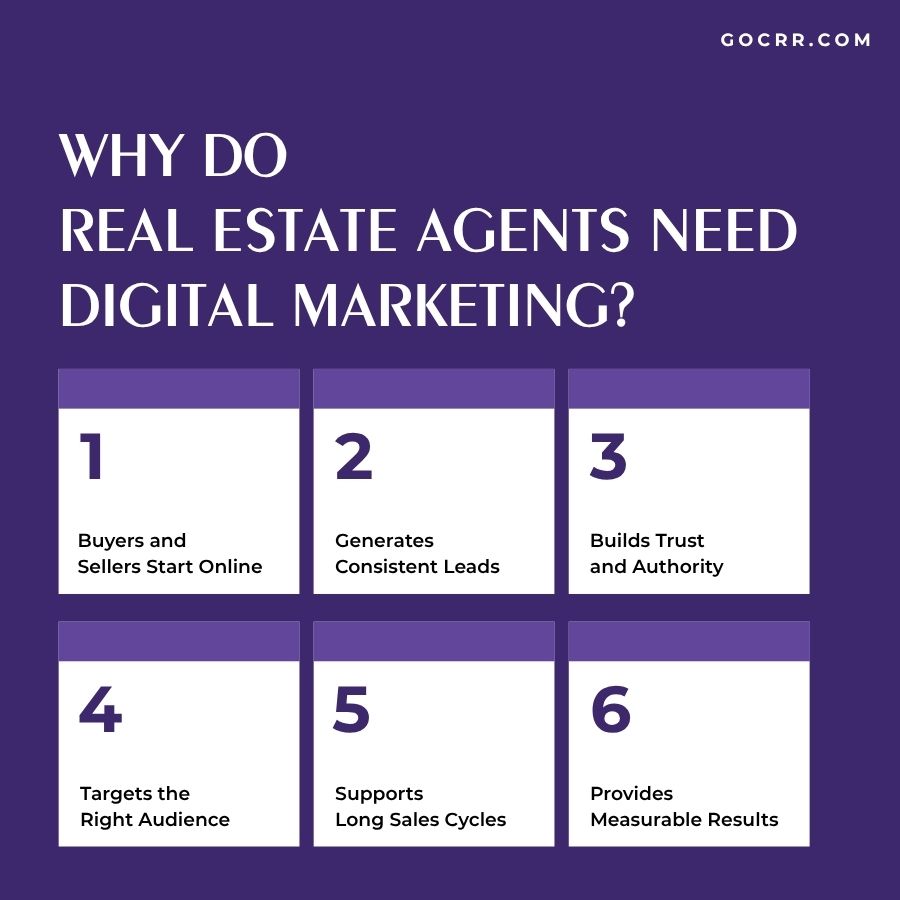
Why Do Real Estate Agents Need Digital Marketing?
Buyers and Sellers Start Online
Today, the majority of homebuyers and sellers begin their real estate journey online. They research local market conditions, estimate their home’s value, and explore available properties before speaking with an agent. This behavior creates a valuable opportunity for real estate agents to position their services where leads are already looking.
Moreover, the data support this shift. Approximately 37% of buyers and 36% of sellers report finding their agent through an online search, surpassing those who found their agent through referrals. This alone highlights just how essential a strong digital presence has become for today’s Realtors.
Generates Consistent Leads
When implemented effectively, digital marketing can create a steady pipeline of leads into your customer relationship management (CRM) strategy. With the right technology in place, Realtors can automate follow-up communications, nurture prospects consistently, and improve conversion rates.
This level of automation allows you to focus your time on meaningful client interactions and income-producing activities. More importantly, you won’t have to worry about spending hours manually sorting and managing leads.
Builds Trust and Authority
Your published resources, such as educational video content, virtual tours, informative guides, and authentic client reviews, are extremely impactful. This strategy positions you and your real estate business in the marketplace. More specifically, these materials provide an opportunity to demonstrate your expertise, highlight your local knowledge, and address common questions.
To better understand the impact of social proof on your lead generation, review our guide, “How to Use Client Testimonials to Enhance Realtor Brand.”
Targets the Right Audience
With targeted marketing campaigns, you can reach a highly specific audience based on factors such as location, stage in the buying or selling process, and even age group. By setting these parameters with online advertising platforms, you can target individuals likely to need your services.
Supports Long Sales Cycles
The home–buying and selling journey is often a lengthy decision-making process. Digital marketing allows you to remain visible and relevant to prospective clients as they begin making those decisions.
By maintaining consistent communication through email marketing, social media, and targeted outreach, you reinforce your presence and build trust. This steady connection positions you as the professional they choose when they are ready to move forward.
Provides Measurable Results
While digital marketing is highly effective at reaching a targeted audience, it also provides measurable insight into campaign performance. Real estate professionals can track key metrics such as clicks, lead submissions, and conversion rates. With this information, agents can evaluate what is working and where adjustments are needed.
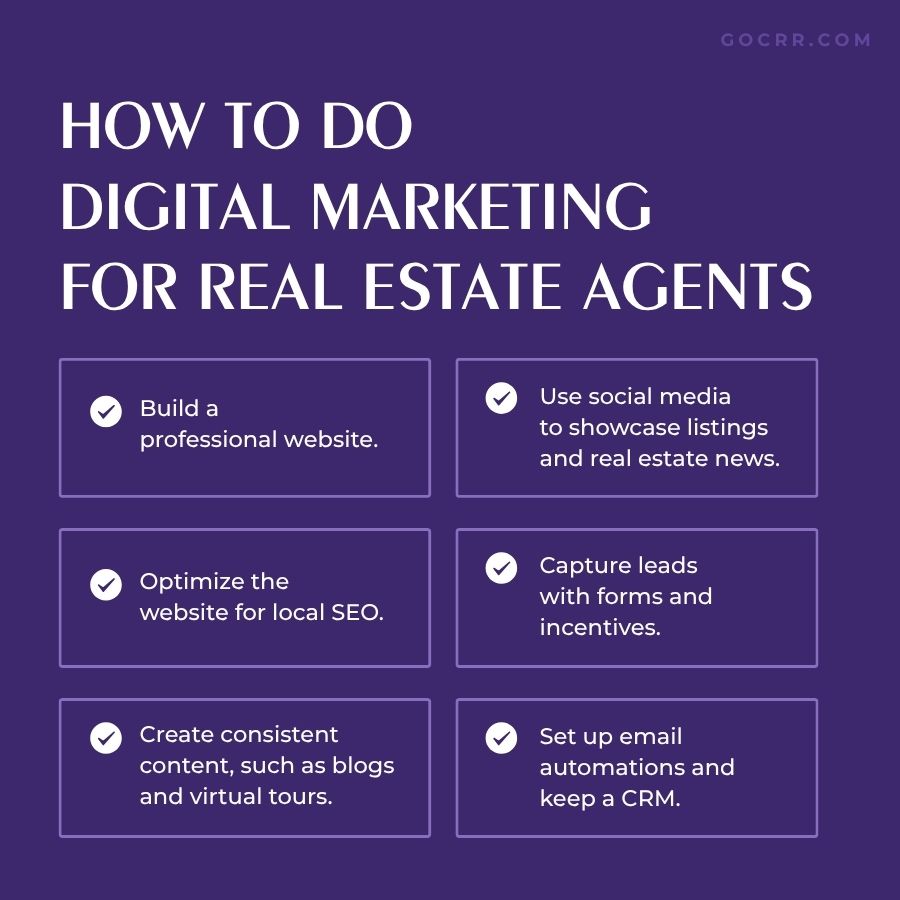
How to Do Digital Marketing for Real Estate Agents
Build a professional website.
The foundation of any successful digital marketing strategy is a professional real estate website. Avoid viewing your website as a simple online business card. Think of it as a comprehensive platform that highlights your expertise, services, and experience.
Equally important is ensuring your website is designed with a mobile-first approach. 80% of real estate website traffic comes from mobile devices, making seamless smartphone navigation critical. A responsive, user-friendly design improves the client experience and increases visitor conversion.
Optimize the website for local SEO.
After building your website, the next step is to optimize it so it appears in relevant Google search results. This process, known as search engine optimization (SEO), accounts for 53% of agents’ website traffic. It involves both technical improvements, such as page speed and site structure, as well as strategic content adjustments, including keyword optimization and on-page SEO elements.
When applied effectively, SEO helps your website rank for topics that buyers and sellers are actively searching for. Publishing targeted, locally focused real estate blog content can significantly increase your visibility online. Over time, this consistent presence helps attract qualified prospects who are already interested in your services and your market.
Create consistent content, such as blogs and virtual tours.
While your primary responsibility is facilitating real estate transactions, maintaining consistent content creation is critical in effective digital marketing. This may include producing virtual tours of your listings, developing a video marketing plan, and publishing articles to target relevant search terms.
Incorporating video into your marketing efforts can deliver measurable results. Research shows that listings featuring video generate 49% more qualified leads. Additionally, 73% of homeowners prefer to work with agents who use video to showcase properties.
Use social media to showcase listings and real estate news.
In addition to publishing content on your website, it is also important to promote it across social media platforms. Social media provides an effective channel for expanding your reach, building an online presence, and engaging with a broader audience.
These platforms are ideal for showcasing new listings, sharing local market updates, and delivering valuable insights. Consistent, professional activity on social media helps reinforce your credibility. Moreover, it keeps your services visible to prospective clients.
For additional guidance on building an effective strategy, review our guide “Social Media for Realtors.”
Capture leads with forms and incentives.
Throughout your digital marketing efforts, it is important to remain focused on one primary objective: capturing qualified leads. A consistent lead generation system is the foundation of a reliable client pipeline.
Simple tools, such as contact forms on your website or incentives such as lead magnets, can be highly effective. For example, providing a downloadable guide, market report, or educational resource encourages prospects to engage. In exchange, they give you the opportunity to begin building a professional relationship.
Set up email automations and keep a CRM.
Once a prospective client provides their contact information, timely follow-up becomes critical. Research shows that responding quickly—ideally within the first few minutes—significantly increases the likelihood of converting the inquiry into a meaningful conversation. However, 62% of real estate inquiries occur outside of standard business hours, making immediate personal outreach challenging.
This is where automated communication systems can provide a valuable advantage. When a lead enters your CRM through a website form, an automated email response is sent instantly. This message can acknowledge the inquiry and provide helpful next steps to schedule a consultation. Implementing this process ensures consistent follow-up while protecting valuable opportunities.
Digital Marketing Tools for Real Estate Agents
CRM Tools for Lead Management
Real estate agents often interact with hundreds of prospective clients, making it difficult to manage every conversation without a system. Implementing a CRM platform, like Wise Agent, enables you to organize contacts, track interactions, and deliver targeted follow-ups more efficiently. A reliable CRM saves time, strengthens lead management, and keeps your pipeline moving forward.
Email Marketing Platforms
Email marketing consistently outperforms many other digital channels in both engagement and return on investment. Therefore, it is a foundational component of an effective marketing strategy. Consistent communication enables you to share valuable information, maintain relationships, and remain top of mind.
A dedicated email marketing platform can further enhance these efforts by organizing contacts into targeted segments and automating newsletters. Tools such as Follow Up Boss enable real estate agents to manage communication efficiently and automatically.
To learn more, see our guide, “Email Marketing for Real Estate Agents.”
Social Media Schedulers
Managing social media can be time-consuming, particularly while balancing content creation, audience engagement, and consistent posting. Implementing a social media scheduling tool, such as Buffer, helps streamline this process.
You can plan and schedule content in advance, publishing posts at optimal times. This approach maintains a consistent online presence while freeing up valuable time to focus on income-producing activities.
Website Builders with IDX Integration
When developing your website, it is important to select a platform that offers IDX (Internet Data Exchange) integration. This feature allows you to display local property listings from the MLS and other real estate agencies directly on your website. With this, visitors can search for homes without leaving your site.
Providing real-time listing access encourages prospects to stay engaged with your site. More importantly, it increases the chance that they will actually contact you. In addition, IDX integration enhances your professional credibility and supports visibility, contributing to overall SEO performance.
Elevate your real estate business with Charles Rutenberg Realty and keep 100% of your commission.
A successful career in real estate requires you to take on multiple responsibilities, including developing strong digital marketing capabilities. Digital marketing consistently helps create a steady flow of prospective clients and supports the growth of your professional brand.
It is also important to recognize that effective marketing requires an initial investment of time and resources. When you partner with Charles Rutenberg Realty, you have greater financial flexibility to reinvest in your business with our 100% commission model. In addition, our agents benefit from ongoing training, practical resources, and professional support.
If you are ready to explore what your future in real estate could look like, schedule a call with our broker. We will discuss how to build your career with Charles Rutenberg Realty while keeping more of what you earn.