


Many people assume that real estate agents spend most of their working hours helping clients buy or sell a home. However, the reality is that they spend a majority of their time networking, marketing, and generating leads to grow their business. While many agents default to broad marketing strategies, those who narrow their focus on a specific area often see more sustainable and consistent results.
That’s where real estate farming comes in. Rather than reaching broadly, farming builds relationships with homeowners in a defined area over time. The ultimate goal is to become the go-to agent in that real estate market. As a concept, the strategy is straightforward. In practice, consistent execution is where most agents fall short.
In this guide, we explain how to effectively and consistently farm a neighborhood in real estate to get more listings. Additionally, we’ll explore what farming means, how to identify motivated sellers within a target area, and provide the step-by-step process for building a presence that generates listings over time. By the end, you will have a clear framework to incorporate this tactic into your broader marketing strategy.
How to Farm a Neighborhood in Real Estate: Step-by-Step Guide
When homeowners are ready to sell, they tend to choose an agent who knows their neighborhood well. And if that agent has already made an effort to build a relationship with them, the decision becomes even easier. Neighborhood farming is how real estate agents establish that presence. They become the trusted local resource people turn to when they are ready to buy or sell a home.
That said, neighborhood farming requires dedication and a lot of patience. It can take months, sometimes over a year, for agents to build a meaningful presence and relationships with homeowners. The time investment is lucrative, though. The agents who show up consistently tend to build reliable pipelines and grow their businesses.
Learn more about the farming in the Clearwater area by reading our guides, “What to Do in Clearwater, FL,” and “Beaches Close to Clearwater, FL.”
What Does Farming a Neighborhood in Real Estate Mean?
Neighborhood farming is a real estate lead-generation strategy built around a consistent presence and relationship-building within a defined geographic area. This strategy involves sending mail campaigns to homeowners, door–knocking, hosting open houses, distributing business cards, and attending community events. These efforts work to build relationships and connections over time.
Ultimately, the goal is straightforward. Become the local real estate market expert that homeowners in that area think of when buying or selling a home.
It is important to understand that farming is a long-term strategy. Most agents do not see listing opportunities until 6 to 18 months into consistent effort. More specifically, repetition and visibility serve as the backbone of this strategy. In practice, this looks like spending time in one neighborhood and sharing the same message over an extended period.
For Clearwater agents, there are various markets you can begin farming in that offer valuable results. To start, review our guide, “Crest Lake Park, Clearwater, FL: The Hidden Gem That Sells Itself.”
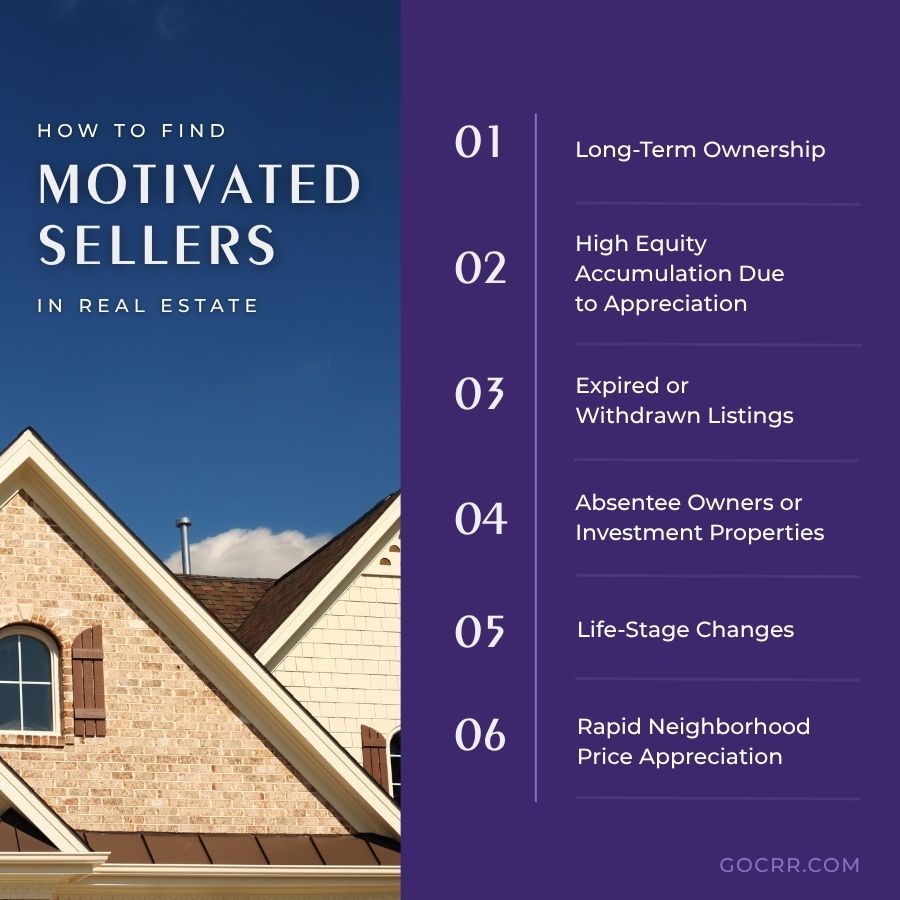
How to Find Motivated Sellers in Real Estate
Long-Term Ownership
Homeowners who have lived in the same property for many years often reach natural turning points that make selling a realistic consideration. Their children may have moved out, their mortgage may be nearly paid off, or the home simply no longer fits their lifestyle. Additionally, these owners typically carry significant equity, giving them the financial flexibility to sell without pressure.
County property appraiser records and MLS property history are two of the most accessible sources for identifying long-term owners in a target area. Real estate data platforms such as PropStream and REDX can also help you compile ownership data when farming a larger area.
High Equity Accumulation Due to Appreciation
Agents can find homeowners with significant equity by comparing the original purchase price with the home’s current market value. This calculation shows exactly how much appreciation accumulated over their ownership. You can use valuation tools such as Zillow and Redfin to quickly estimate the current value. However, pulling comps manually through the MLS tends to produce a more accurate picture.
Neighborhoods that have experienced strong price growth over the past 5 to 10 years are particularly strong farming targets. Cross-referencing purchase dates with historical price trends in a specific area helps narrow the list to homeowners who are sitting on substantial gains. When they realize that, they may be more motivated to act on it.
Expired or Withdrawn Listings
The easiest way to find expired or withdrawn listings is through the MLS. Simply filter the search for listings with a change of status in the last 6 to 12 months. Homeowners who were unsuccessful in selling often still have a strong motivation, making the conversation easier.
Reaching out with a fresh perspective and updated market insights positions you as the solution to a problem they are actively trying to solve. And that is an easier conversation than convincing someone who has not yet considered selling.
Absentee Owners or Investment Properties
Absentee owners represent a consistently strong lead source for listing agents. Managing a rental property from a distance becomes burdensome over time. Tenant turnover, maintenance calls, and property management fees that erode profitability all create natural motivation to sell.
Many investments also reassess their portfolios periodically, looking to cash out on properties that have appreciated since purchase. Others may have inherited property and prefer to sell rather than manage it remotely.
Identifying absentee owners is straightforward through county tax records, where the absence of a homestead exemption indicates the property is not owner-occupied. A mailing address that differs from the property address is another reliable indicator worth noting when compiling your outreach list.
Life-Stage Changes
Life-stage changes are among the most reliable predictors of seller motivation. Empty nesters frequently look to downsize once their children move out. Meanwhile, growing families outgrow starter homes and need more space. Needless to say, divorce, retirement, and job relocation each create a different kind of urgency. However, they all also tend to move a homeowner toward a quick decision.
Several channels are available to agents to identify sellers who have experienced life-stage changes. For example, directly searching divorce filings, which are public in most counties, allows you to identify potential sellers, buyers, and renters. Moreover, retirement communities and 55-plus neighborhoods are strong farming targets, as residents there are already at a life stage where a move is a natural next step.
Rapid Neighborhood Price Appreciation
Rapid price appreciation creates motivated sellers by putting homeowners in a position they did not anticipate. Now, they hold far more equity than they expected when they first purchased the home. This significant appreciation may be the motivation they need to sell and cash in their investment.
Agents can pull historical sales data through the MLS to identify the streets or blocks where prices have climbed over the past several years. Cross-referencing that data with purchase dates helps narrow down the list to long-term owners who bought before the appreciation began. This is where numbers do the convincing; you simply have to share the information.
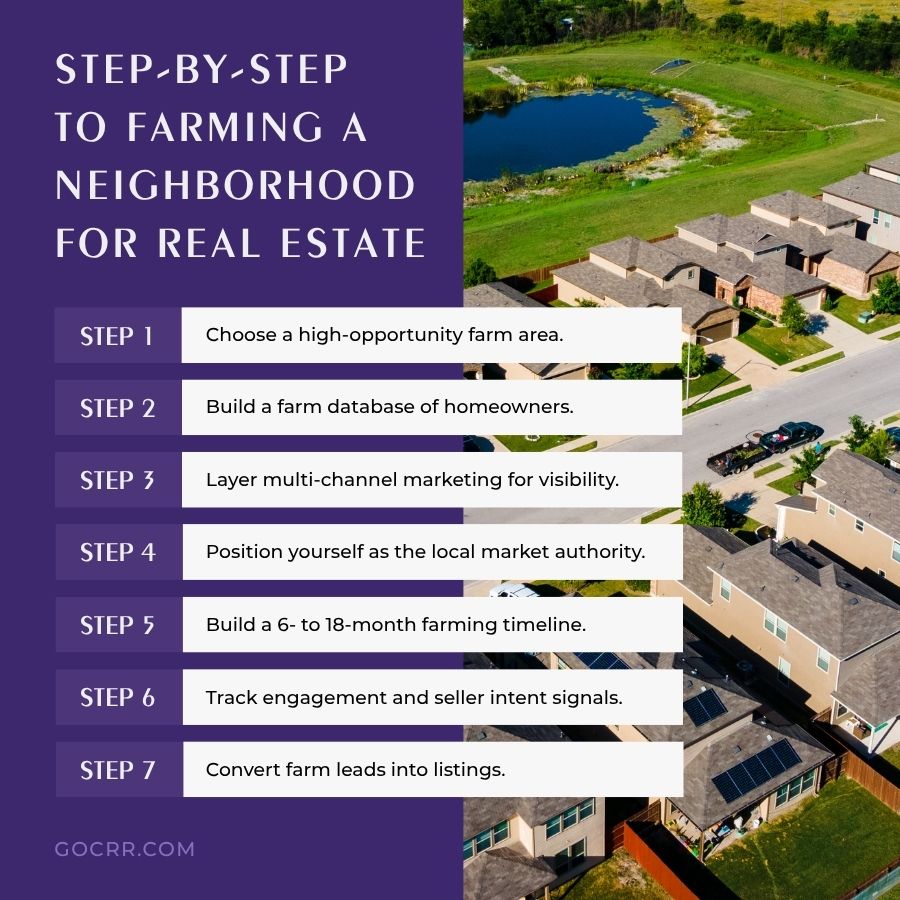
Step-by-Step to Farming a Neighborhood for Real Estate
Step 1: Choose a high-opportunity farm area.
Choosing a high-opportunity farm area starts with data, not personal preference. Agents often gravitate toward neighborhoods they are familiar with or already live near, but familiarity alone does not guarantee results.
In fact, the strongest farm areas share two defining characteristics. They have predictable turnover and strong homeowner stability. Turnover rate reflects how frequently homes actually sell in a given area. Meanwhile, stability points to the long-term ownership patterns most worth targeting.
Reviewing MLS sales history and county records over several years is the most reliable method. From this, you can identify which neighborhoods consistently meet both criteria before committing time and resources to farming.
Step 2: Build a farm database of homeowners.
Building a farm database means converting the neighborhood from a loose list of addresses into an organized, actionable system. Start by pulling every homeowner in the target area from county records, then categorize each contact by type. Long-term owners, absentee owners, and expired listings each warrant a different outreach approach.
Tagging contacts in specific categories allows you to prioritize outreach toward the homeowners most likely to sell. A well-structured database also makes tracking follow-up dates and response history more manageable. As your farming efforts grow over time, this information is a major resource.
To help you stay organized while farming, check out the tools agents use in our guide “Technology for Real Estate Agents.”
Step 3: Layer multi-channel marketing for visibility.
Most agents rely on postcards alone when farming a neighborhood. Ultimately, however, the agents who build the strongest farm presence layer multiple touchpoints to stay consistently visible across different contexts.
That said, direct mail still matters. Sending postcards and marketing material on a monthly schedule builds brand recognition over time. Furthermore, door knocking adds a personal dimension that mail cannot, particularly when paired with a useful leave-behind item like a door hanger.
You can also utilize digital marketing while farming. For example, social media geo-targeting also allows you to run ads specifically to residents within your farm boundaries. This reinforces your presence online between physical touchpoints.
Finally, hosting or sponsoring local business and community events builds genuine relationships and positions you as a figure in the neighborhood. Effective and meaningful effects include neighborhood cleanups or holiday gatherings where you can interact with homeowners face-to-face. Additionally, they benefit the community and its homeowners, creating an overall positive experience.
Step 4: Position yourself as the local market authority.
Visibility puts your name in front of homeowners, but authority converts that recognition into trust. Once people know who you are, they need a reason to believe you understand their specific market, not just general real estate.
Publishing regular local market updates is one of the most effective ways to establish that credibility. Sharing recent sales data specific to the farm area shows homeowners exactly how their neighborhood is performing. For homeowners, this is far more compelling than broad market statistics that could apply to any market.
You can further reinforce your expertise through social media recaps or a consistent newsletter sent out to the neighborhood. These methods turn casual name recognition into genuine confidence in your knowledge over time.
Step 5: Build a 6- to 18-month farming timeline.
Farming a neighborhood is a long-term strategy, and setting realistic expectations from the outset is essential. Most farming efforts take between 6 and 18 months before consistent leads begin to emerge. The early months rarely produce inbound calls, but that silence does not mean the strategy is failing. It simply means you are still building the foundation.
A realistic timeline might look something like this:
- 1-3 months: Sending monthly postcards establishes initial name recognition in the area.
- 4th month: Door–knocking begins along with a quarterly local market update mailed to the neighborhood.
- 9th month: Reinforce your presence digitally with social media geo-targeting ads to complement physical touchpoints.
- 12th month: Homeowners often recognize your name without prompting, and inbound inquiries begin to appear more naturally.
Step 6: Track engagement and seller intent signals.
Measurement is what separates productive farming from efforts that simply cost time and money without clear direction. Without tracking, there is no reliable way to know which touchpoints are generating interest and which are not producing results.
Keeping a well-maintained log or CRM system ensures all of your data is in one place. Measuring data such as who you sent postcards to, the conversations you had while door–knocking, or email responses is all relevant and helpful.
Moreover, reviewing that data consistently allows you to spot seller intent signals early. For example, these can show up as a homeowner replying to a market update or attending a local event. Those signals often appear before a homeowner reaches out directly, and agents who check their data tend to catch them before a competitor does.
Step 7: Convert farm leads into listings.
Converting leads into listings is the step that makes the entire farming effort worthwhile. However, it requires agents to act quickly the moment seller intent appears.
When a homeowner replies to one of your postcards or asks about recent neighborhood sales, it is a seller-intent signal. This is your moment to follow up as promptly as possible before another competitor starts a conversation. Agents who treat these moments as immediate priorities consistently close more listings than those who let warm leads sit untouched.
Become the go-to real estate agent in Clearwater with Charles Rutenberg Realty and keep 100% of your commission.
Agents who commit their time and resources to a specific geographic area consistently facilitate more transactions than those who spread their efforts broadly. Neighborhood farming is one way to make that possible. However, the strategy only works with time, consistency, and a willingness to stay the course before the results become visible.
At Charles Rutenberg Realty, we support agents who want to become the go-to local expert in their chosen market. For more than 20 years, we have built a standard of excellence in Florida that gives our agents a recognized brand to stand behind. It’s one that communicates credibility and elevated service to current and potential clients before the first conversation ever takes place.
And with our 100% commission model, you keep more of what you earn on every transaction. That means more resources to reinvest in your farming strategy, marketing materials, and your business’s long-term growth.
If you are ready to build your real estate reputation in Clearwater and the surrounding area, schedule a call with our broker today.