

If you’ve ever wondered how many houses Realtors sell a year, you’re in good company. It’s one of the most searched questions in the real estate market, and the answer matters to a lot of different people. Some readers are weighing a real estate career. Others are choosing an agent to handle a home sale. And many are agents themselves, quietly benchmarking their own production against the field.
The honest answer is that it depends. Annual production varies based on experience, market conditions, location, and business strategy. A first-year agent and a seasoned team leader operate in completely different worlds, even when they hold the same license.
This guide breaks down the factors that shape those numbers, what the industry data actually says, and how top producers consistently sell more homes.
How Many Houses Do Realtors Sell a Year: A Data-Backed Guide
Production varies widely, and it depends on far more than simply holding a license. A licensed part-time agent who closes a handful of deals each year and a full-time professional running a busy pipeline may both be included in the same industry averages. That’s why raw averages can be misleading if you don’t understand what sits underneath them.
There’s also an important measurement caveat. Industry figures usually count “transaction sides,” not houses. For every real estate transaction, there are two sides: the agent that represents the buyer and the agent that represents the seller. On occasion, the same agent may represent both, in which case that Realtor would earn the commission from both sides.
So when someone says an agent “sold 10 homes,” the number often reflects 10 sides, a mix of listings sold and buyers helped. Keep that distinction in mind as you read any statistic, whether it’s your own or a competitor’s.
What Is the Average Number of Houses a Realtor Sells in a Year?
The National Association of REALTORS® (NAR), surveys its membership annually. According to the newest data, the typical agent closed nine transaction sides in 2025, with a median individual sales volume of $2.7 million for brokerage specialists.
In prior years, that figure held closer to 10, so the recent number reflects a slower market. Averages, though, hide enormous range. Experience is the single clearest dividing line.
Realtors with 16 or more years of experience reported a median gross income of $88,500, while members with two years or less in the business earned a median of $8,000. Production tracks a similar curve, and mid-career agents often lead the pack.
Florida agents should read national figures with local context. In 2024, the typical agent in Florida had seven transactions compared to 10 transactions nationally, and the median sales volume for brokerage specialists was $1.8 million.
A competitive market like Clearwater carries a high agent count, so the spread between the median and the top tier is wide. Use these averages as benchmarks, not expectations. They describe where the middle of the field sits. They don’t set a ceiling on what a focused agent with the right support and systems can build.
What Factors Affect Realtor Home Sales?
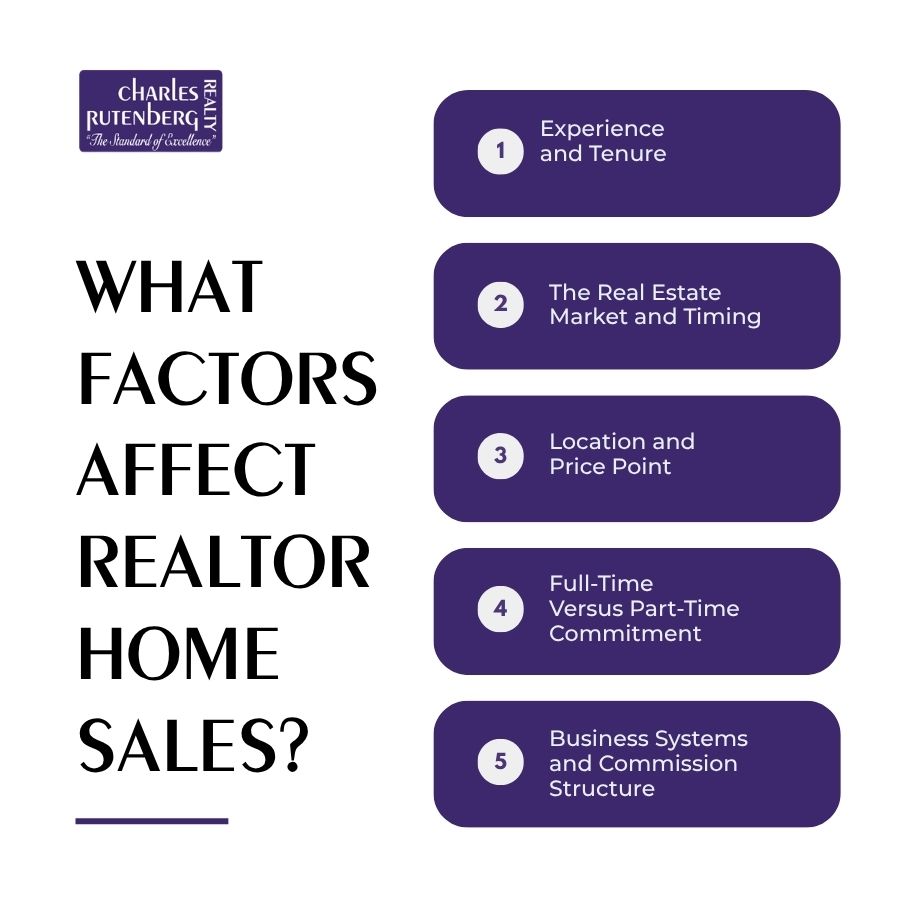
Several forces shape how many homes a Realtor closes in a year. Understanding them helps you read any production number in context, and it points to what you can actually influence.
Experience and Tenure
Experience compounds. Newer agents spend most of their energy prospecting, while veterans lean on relationships. NAR found that the longer real estate professionals stay in the business, the more clients come to them, reducing the need to constantly prospect.
Additionally, among agents with over 16 years of experience, 40% said more than half of their business was made up of repeat clients. That referral engine is why tenure correlates so strongly with volume.
The Real Estate Market and Timing
The broader real estate market sets the ceiling for everyone. Existing-home sales have been running near 4 million units annually, the slowest pace since 1995, with the market described as operating under suppressed conditions for more than three years.
When inventory is tight and rates are high, even strong agents close fewer deals. Florida agents feel this directly, since housing affordability was the commonly cited barrier preventing potential clients from buying a home.
Location and Price Point
Where you work, and at what price point, changes the math. The cost of a home directly affects what an agent earns per sale.
An agent in a market where homes average $200,000 needs to close more sales to earn what an agent selling $1 million homes earns from a fraction of the volume. A luxury specialist and a starter-home specialist can post very different unit counts and comparable incomes.
Full-Time Versus Part-Time Commitment
Hours matter. Agents who don’t work full-time close fewer deals, and the official averages already lean toward active professionals. The typical Realtor worked 35 hours per week in 2024, up from 25 hours per week in 2023. Consistent, full-time effort is one of the clearest separators between a few transactions and a steady pipeline.
Business Systems and Commission Structure
How an agent runs their business, including their brokerage and commission structure, affects both volume and take-home pay. Transaction fees, brokerage splits, and monthly costs all eat into margins.
An agent who keeps more of each check can reinvest in marketing, which fuels the next home sale. A model built around a 100% Commission real estate brokerage, low transaction fees, and a predictable flat fee lets agents scale without handing away a growing share of every deal.
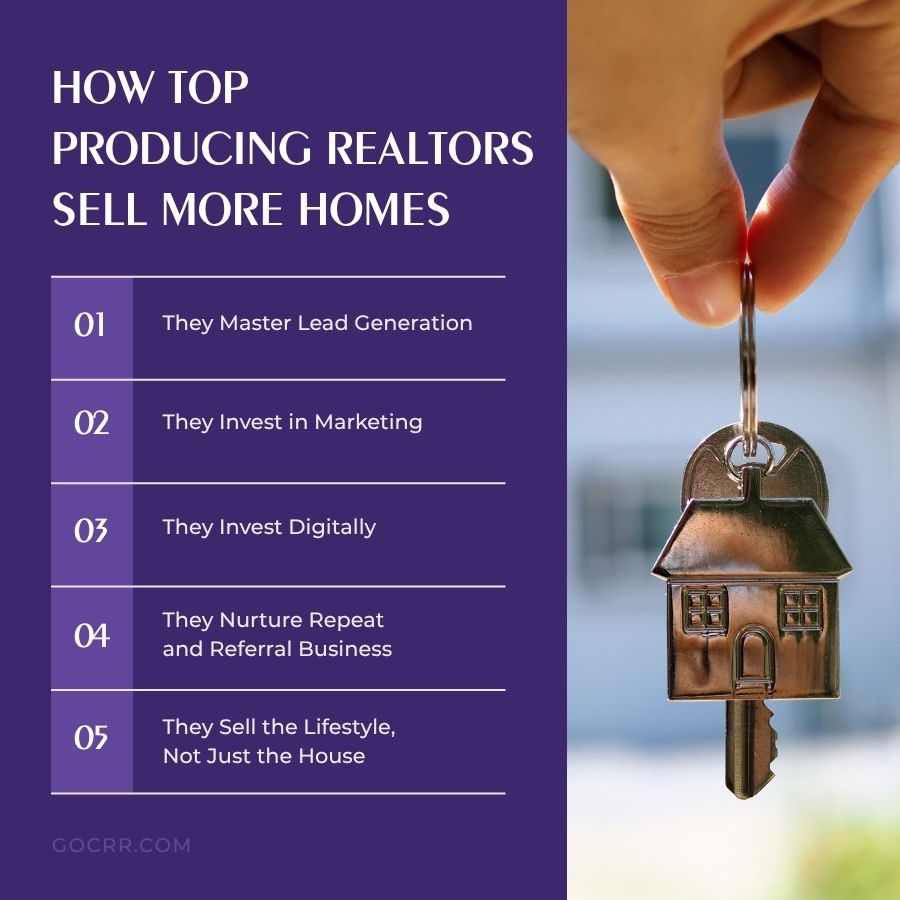
How Top Producing Realtors Sell More Homes
Top producers rarely rely on luck. They build repeatable systems. The strategies below show up again and again among agents who outperform the average, and they’re practical rather than guaranteed.
They Master Lead Generation
High-volume agents treat lead flow as a system, not a hope. They mix referrals, past-client outreach, online leads, and community presence so their pipeline never runs dry. For a deeper overview, we recommend reading our article, “Real Estate Lead Generation Ideas,” which walks through tactics you can put to work immediately.
They Invest in Marketing
Consistent marketing keeps top agents visible when buyers and sellers are ready to move. Strong branding, professional listing presentation, and steady follow-up turn attention into appointments. Our guide to “Marketing for Realtors” covers how to build a presence that compounds over time.
They Invest Digitally
The best producers meet clients where they already spend their time, which today, means online. From search-friendly listings to social content and email nurture, digital reach multiplies a single agent’s footprint. Learn more by reading our article, “Digital Marketing for Real Estate Agents,” for a step-by-step approach.
They Nurture Repeat and Referral Business
The most efficient volume comes from people who already trust you. NAR found that Realtors typically earned 20% of their business from repeat clients and 21% through referrals. Top producers protect those relationships with regular, genuine contact, and it pays them back for years.
They Sell the Lifestyle, Not Just the House
In a place like Clearwater, buyers aren’t only choosing a floor plan. They’re choosing beach mornings, walkable parks, and Tampa Bay’s year-round outdoor pace. Agents who can speak to that lifestyle connect faster and close more confidently. For buyers encountering the area for the first time, your role is to bridge that gap between a listing and a life.
Begin learning how to sell more homes with Charles Rutenberg Realty.
Where an agent hangs their license shapes everything above. The right real estate brokerages give agents the tools, technology, and economics to grow, rather than draining their momentum through high splits. This is where a model built for producers becomes a genuine advantage.
That’s exactly the foundation Charles Rutenberg Realty was built to provide. Founded in 2000, the brokerage is one of the largest and most respected real estate companies in the region. With 2,100+ agents, low transaction fees, and a technology-driven, collaborative environment, we give Florida agents room to scale their production.
When a transaction closes, our agents keep 100% of their commission, with no brokerage splits. If you’re ready to grow your annual home sales on a model built around your success, we invite you to get in touch and apply today. Similarly, if you’re interested in buying a home or selling a home, Charles Rutenberg Realty is here to help.
Charles Rutenberg Realty, Clearwater.