

Few careers offer the earning potential found in real estate. As a Realtor, your earnings are not limited by a salary cap or hours worked. Instead, they are tied directly to the number of transactions you successfully guide from contract to closing. The more buyers and sellers you serve, the greater your income potential.
But how exactly do Realtors get paid? How are real estate agent commissions structured? And who ultimately pays those commissions?
These are common questions—both for individuals considering a career in real estate and for those buying or selling a home. In this guide, we explain how Realtor compensation works, what typical commission structures look like, and when agents receive payment.
We will also address several frequently asked questions to help you better understand how Realtors earn their income. By the end, you will have the information to decide whether this career aligns with your goals.

How Do Realtors Get Paid? Real Estate Commission Explained
Traditionally, sellers pay the agent commission for both the listing agent and the buyer’s agent. Because of this structure, it directly affects the final net amount the seller receives. For this reason, it’s essential to clearly review commission terms when signing the listing agreement. Establishing expectations at the beginning of the process helps prevent confusion later on.
Additionally, all parties should understand how they will receive compensation for professional representation. It creates transparency and reduces the risk of misunderstandings between sellers, buyers, and their respective agents.
Who Pays the Realtor Fees: The Buyer or the Seller?
In most transactions, real estate agents get paid by the seller. The commission is deducted from the seller’s proceeds at closing. That total commission is then typically shared between the seller’s agent and the buyer’s agent.
Importantly, the seller and listing agent negotiate the commission terms before the property ever reaches the market. They will also agree on the total commission structure when signing the listing agreement. Once a buyer receives representation in the transaction, the agents determine how they will split the commission.
It is also worth noting that commission practices continue to evolve, particularly following significant industry changes and legal rulings involving the National Association of Realtors (NAR).
Under the updated commission practices, sellers are no longer automatically expected to compensate the buyer’s agent. In some transactions, sellers may choose to pay only their listing agent, while buyers are responsible for compensating their own representative.
This structure can allow sellers to retain a larger share of their sale proceeds. However, it may also influence buyer behavior. Some buyers prefer properties where their agent’s compensation is already addressed within the transaction.
In practice, many sellers continue to follow the traditional approach. Surveys indicate that approximately 92% of agents in Florida report sellers still offering compensation to the buyer’s agent. While the rules have evolved, market norms in many areas remain largely consistent.
When Does a Realtor Get Paid?
Realtors are only paid when a transaction successfully closes. If a deal falls apart before completion, they do not receive commission, regardless of how much time or effort the agent invested.
In a typical transaction, commissions are paid only after several key steps occur:
- The sale officially closes
- Escrow of the title company disburses the funds
- Commission payments are distributed to the brokerages involved
- The broker receives the commission and pays the agent according to their agreement
- All contract conditions are satisfied, and ownership transfers to the buyer
This process means agents often work weeks—or even months—before receiving commission fees. However, as your business grows, you begin managing multiple transactions simultaneously. So, income becomes more consistent and predictable over time.
Are you curious how agents keep track of multiple transactions at once? Review our guide “Technology for Real Estate Agents to Close More Deals” for insider tools proven to help.
How Often Do Realtors Get Paid?
There is no fixed pay schedule in real estate. Instead, Realtors receive compensation when transactions close rather than relying on a weekly or monthly payroll. Because agents operate as independent contractors, their income is directly tied to the timing and volume of their closings.
As a result, earnings can vary month to month. Some months may include multiple successful closings, while others may be quieter. The difference often depends on how many clients you are actively working with and where those transactions are in the process.
While real estate income is not always consistent, the potential upside is substantial. For many professionals, that earning potential more than offsets the variability.

What Percentage Do Realtors Get Paid?
In Florida, the typical real estate commission ranges between 5% and 6% of the property’s final sale price. Moreover, the listing agent and buyer’s agent will generally divide this amount, resulting in an even 2.5%-3% split of the sale price.
It is important to note that commission rates are fully negotiable between the seller and listing agent in Florida. Market conditions, property type, and pricing can all influence the final agreement.
For example, luxury properties operate with slightly lower percentage rates—often between 4% and 5%. However, because transaction values are significantly higher, the agent’s overall commission can still be substantial.
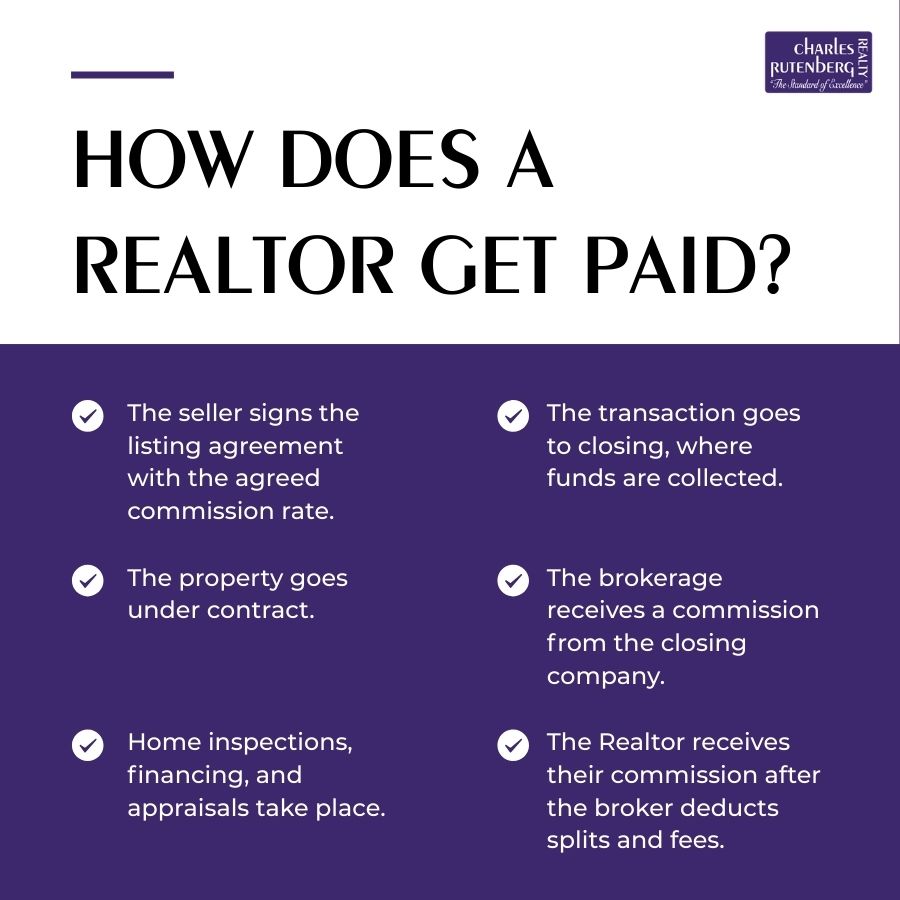
How Does a Realtor Get Paid?
The seller signs the listing agreement with the agreed commission rate.
The Realtor and seller negotiate real estate commission and agent fees at the time the listing agreement is signed. This agreement outlines the commission structure and the percentage the seller agrees to pay for professional representation in the transaction.
During this stage, the seller also determines how compensation will be handled for the buyer’s agent. Many transactions still follow the traditional structure, in which the seller pays both agents. However, current regulations allow sellers to require buyers to compensate for their own representation.
Clarifying these terms at the outset ensures transparency and prevents confusion in the transaction.
The property goes under contract.
After a property goes on the market, it will eventually receive an offer. Once the seller accepts that offer, the property moves under contract, formally beginning the transaction process.
At this point, the path toward closing—and ultimately the agent’s commission—has started. However, several important steps remain before the transactions can be finalized.
Home inspections, financing, and appraisals take place.
As the transaction progresses, several critical steps take place behind the scenes. Home inspections and appraisals are completed, while the buyer’s lender works to finalize financing approval.
These stages can determine whether a deal moves forward or falls apart. Many contracts, for example, include inspection contingencies that allow buyers to renegotiate or withdraw if the inspection reveals significant issues. If major repairs are required and the seller is unwilling to address them or provide concessions, the buyer may choose to terminate the agreement.
This phase of the transaction is often the most delicate. It is also where skilled negotiation becomes essential, as agents work to keep the deal intact while protecting their client’s interests.
The transaction goes to closing, where funds are collected.
If inspections, financing, and all contractual conditions proceed as expected, the transaction moves to closing. This is the stage where buyers and sellers finalize the process. They sign the necessary documents and officially transfer ownership of the property.
At closing, all funds are collected and distributed. The seller receives their proceeds from the sale, while the buyer receives the keys to their new home. However, even at this stage, Realtors do not yet receive their commission. The payment process continues through a few final steps before agents get their compensation.
The brokerage receives a commission from the closing company.
After closing, the commission funds are distributed to the brokerages involved in the transaction. The closing or title company handling the sale typically issues these payments.
In most cases, the brokerage receives the commission directly. Because agents operate under their broker’s license, commissions are paid to the brokerage first. The broker then distributes the appropriate portion to the agent.
The Realtor receives their commission after the broker deducts splits and fees.
This is the stage where Realtors finally receive compensation. Once the brokerage receives the commission, the broker distributes the payment to the agent in accordance with their commission agreement.
At many traditional brokerages, agents work under a commission split structure. More specifically, it is common for brokers to retain 20% to 50% of the agent’s commission, depending on the brokerage model and production level. Additional deductions may also apply, such as flat fee costs for administrative support and errors and omissions (E&O) insurance.
As a result, the agent’s take-home portion may ultimately represent roughly 1.5% to 2.4% of the property’s final sale price. However, alternative brokerage models exist. At Charles Rutenberg Realty, we are a 100% commission real estate brokerage. Instead of a percentage split, agents retain their full commission and pay only flat fees for administrative support and compliance services.
This structure allows agents to keep more of what they earn and reinvest those funds into marketing, systems, and long-term business growth. See exactly how much real estate commission you can earn with us through our Commission Calculator.
Do Realtors Get Paid a Salary?
Realtors do not receive salary payments. Instead, they operate as independent contractors and earn income based on performance.
This 1099 contractor structure involves more than simply working without a regular paycheck. Realtors are also responsible for managing their own financial planning, including retirement contributions, quarterly tax payments, and securing health insurance.
For this reason, a career in real estate should be viewed as launching your own business—supported by the structure and guidance of a brokerage. You control your schedule, your income potential, and ultimately your financial future. For some professionals, that level of independence is highly appealing. For others, it requires careful consideration before entering the industry.
Frequently Asked Questions About Realtor Compensation
Do Realtors get paid hourly?
Realtors are not paid hourly. Their compensation is commission-based, and they receive payments only after a transaction closes successfully.
Additionally, the timeline for each transaction can vary. Some deals may close within a few weeks, while others can take several months to complete. Regardless of the process length, the agreed-upon commission structure remains the same.
Do Realtors get paid for rentals?
Yes, Realtors can earn commissions by assisting property owners with rental listings. In many markets, the standard compensation for securing a tenant is equivalent to one month’s rent.
Similar to a home sale, this commission is typically paid once the lease agreement is finalized and the tenant takes occupancy. The payment is then processed through the brokerage and distributed to the agent’s broker according to the agent’s commission.
Do Realtors get paid for showings?
Realtors are not paid for individual activities such as conducting property showings. Instead, all work performed throughout the transaction—showings, marketing, negotiations, and client guidance—is within the commission paid at closing.
In other words, agents are compensated for the successful completion of the entire transaction, not for the individual steps required to get there.
Do Realtors get paid on new construction?
Yes, Realtors can earn commission on new construction home purchases. In most cases, the builder compensates the agent for representing the buyer. Builders often include this cost within their marketing and sales budgets. This allows buyers to receive professional representation without an additional out-of-pocket expense.
Do Realtors get paid for referrals?
Realtors can earn income through referral agreements with other agents or brokers. This is a common way to generate additional revenue, particularly when a client is relocating outside your service area.
In a typical referral agreement, the referring agent receives a percentage of the commission earned by the agent who closes the transaction. That referral fee is often around 25% of the gross commission, though parties will negotiate the exact amount.
Do Realtors get paid if a house doesn’t sell?
If a property does not sell, a Realtor does not receive a commission. Real estate commission is tied directly to a successful closing when buying and selling a property.
Since commissions are paid from the seller’s proceeds at the time of sale, agents are compensated only when the transaction is complete. This means Realtors often invest significant time and effort marketing the property, hosting showings, negotiating offers, and guiding the transaction—without payment unless the home sells.
Keep 100% of your real estate commission with Charles Rutenberg Realty.
A career in real estate offers significant income potential. However, agents only earn income when a transaction successfully closes. In many traditional brokerage models, agents must then divide their commission with the brokerage, reducing their final take-home pay.
There is another approach, though.
At Charles Rutenberg Realty, agents operate under a 100% commission structure. There are no percentage-based brokerage splits, and agents retain the full commission they earn while paying only flat transaction-related fees.
Importantly, this model does not mean sacrificing support. Our agents receive professional tools, training programs, and ongoing guidance designed to help them grow their businesses with confidence. Are you interested in building a real estate career while keeping more of what you earn? Schedule a call to explore opportunities with Charles Rutenberg Realty.